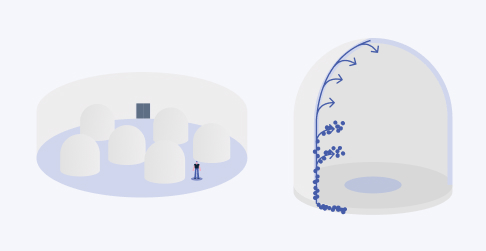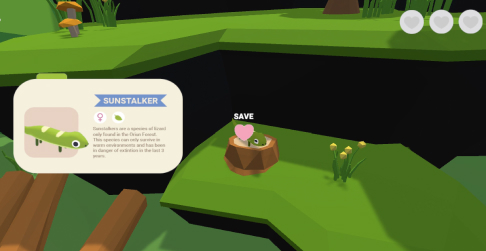
Alief is an immersive experience presented as an installation, developed through the lens of affective computing. Our aim is to create a space that offers a fresh perspective on the concept of dating, inviting an introspective journey of self-discovery within this theme. The term "alief" refers to a belief we rationally know to be false, yet which persists in our subconscious and influences our decisions. In this context, the "alief" we explore is the enduring idea of a "perfect match" or "soulmate."
Context
This project was developed for the Interaction Design course, with the chosen theme of Affective Computing. It explores how rapid technological and social changes, described by Klaus Schwab as the Fourth Industrial Revolution, are reshaping human interaction.
This new era is defined by the convergence of physical, digital, and biological technologies, leading to more seamless and emotionally aware interactions between humans and machines. Affective Computing plays a central role by focusing on technology that can recognize, interpret, and respond to human emotions.
Problem Statement
As time goes by, the evolution of technology continues to shape the way we see ourselves and others. With the rise of social media, we've begun to believe in realities that are, in truth, nothing more than carefully curated snapshots of life. Dissatisfaction and envy (wanting what others are or have) fuel our capitalist system daily. We're constantly bombarded with the illusion of perfection and unattainable ideals, which inevitably affects the way we relate to others and to ourselves.
A reflection of this is the emergence of dating apps, a concept that tries to convince us that what's missing from our quest for perfection is simply another person.
Yet, these apps have largely reinforced a culture of hook-ups and superficial choices based on appearances. It's nothing new; it's just a digital version of what already happens in the real world. In other words, this reality didn't change, it just got a makeover and moved to our living rooms.
Looking at this behavior more closely, we run into what might be the biggest flaw in these platforms: too many options. When someone who's already feeling unsatisfied is given endless possibilities, the result is often shallow, disposable connections.
It makes us wonder...do we even know what's truly good for us?
Goals
Offer a new perspective on dating and online connections through the use of Affective Computing, framing the experience as a date with AI to prompt reflection on contemporary dating culture.
Help participants recognize the near impossibility of achieving a "perfect" relationship, understand that the person we imagine as ideal often differs from what we truly want or need, and reveal that this imagined figure is a fictional construct shaped by cultural ideas and external influences.
Constraints
- Installation Format: The work had to take the form of an installation.
- Limited Experience: The team's prior experience was not solely focused on interaction design, requiring us to explore unfamiliar design processes and methodologies.
- Thematic Alignment: The concept needed to align with the theme of Affective Computing.
- Speculative Design: The project centered on technology we did not fully understand at a technical level, demanding a speculative design approach rather than a functional implementation.
Design Process
1. Project Definition
We began the design process by conducting benchmarking to gather insights and inspiration. This involved analyzing two dating apps—Tinder and Invisible Boyfriend—as well as art installations such as Memopol-3, TeamLab Borderless, and Future You. While the installations did not share our exact thematic focus, some aligned with the aesthetic qualities and experiential atmosphere we envisioned for our own work. These references helped shape our conceptual and visual direction.
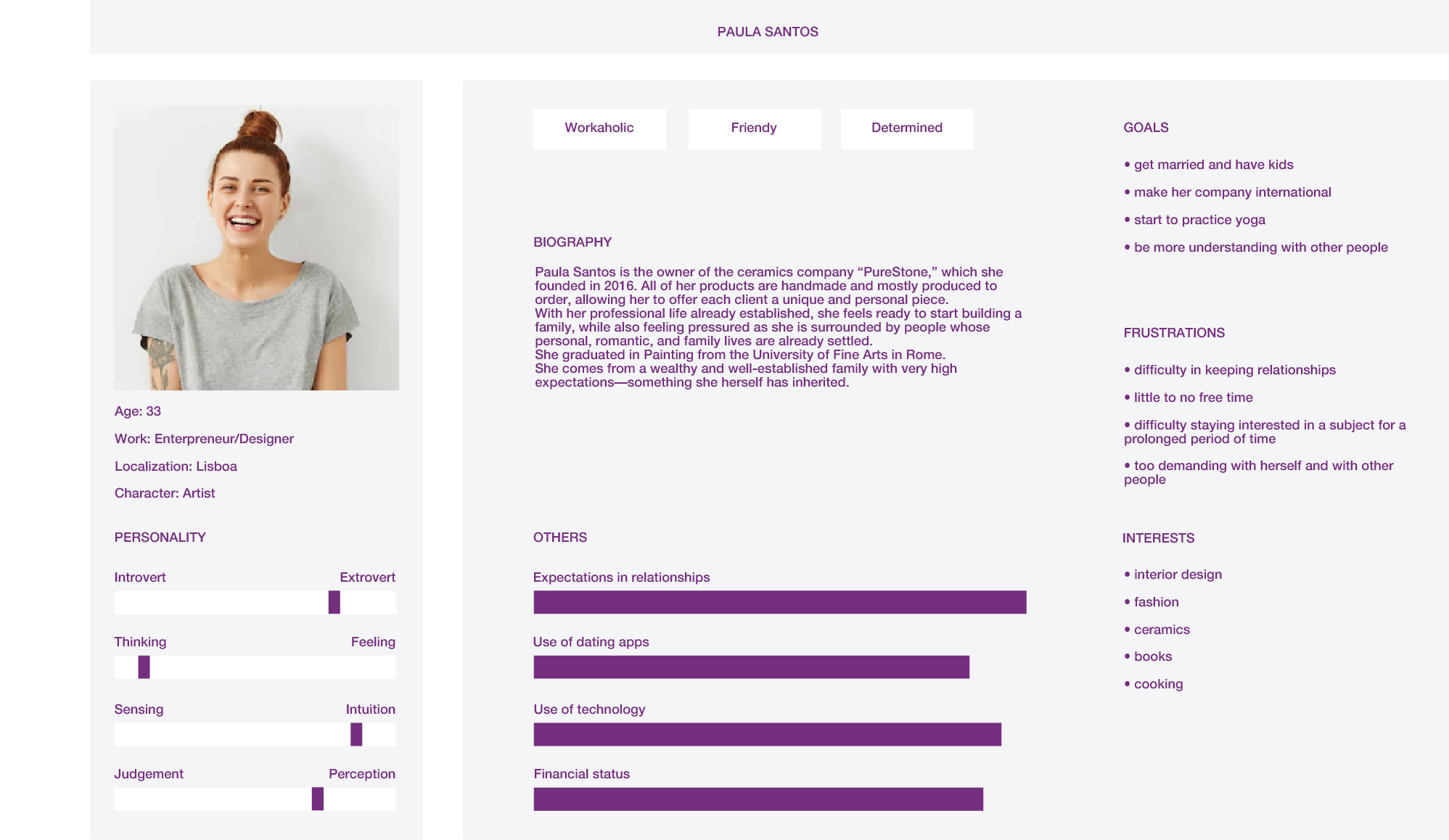
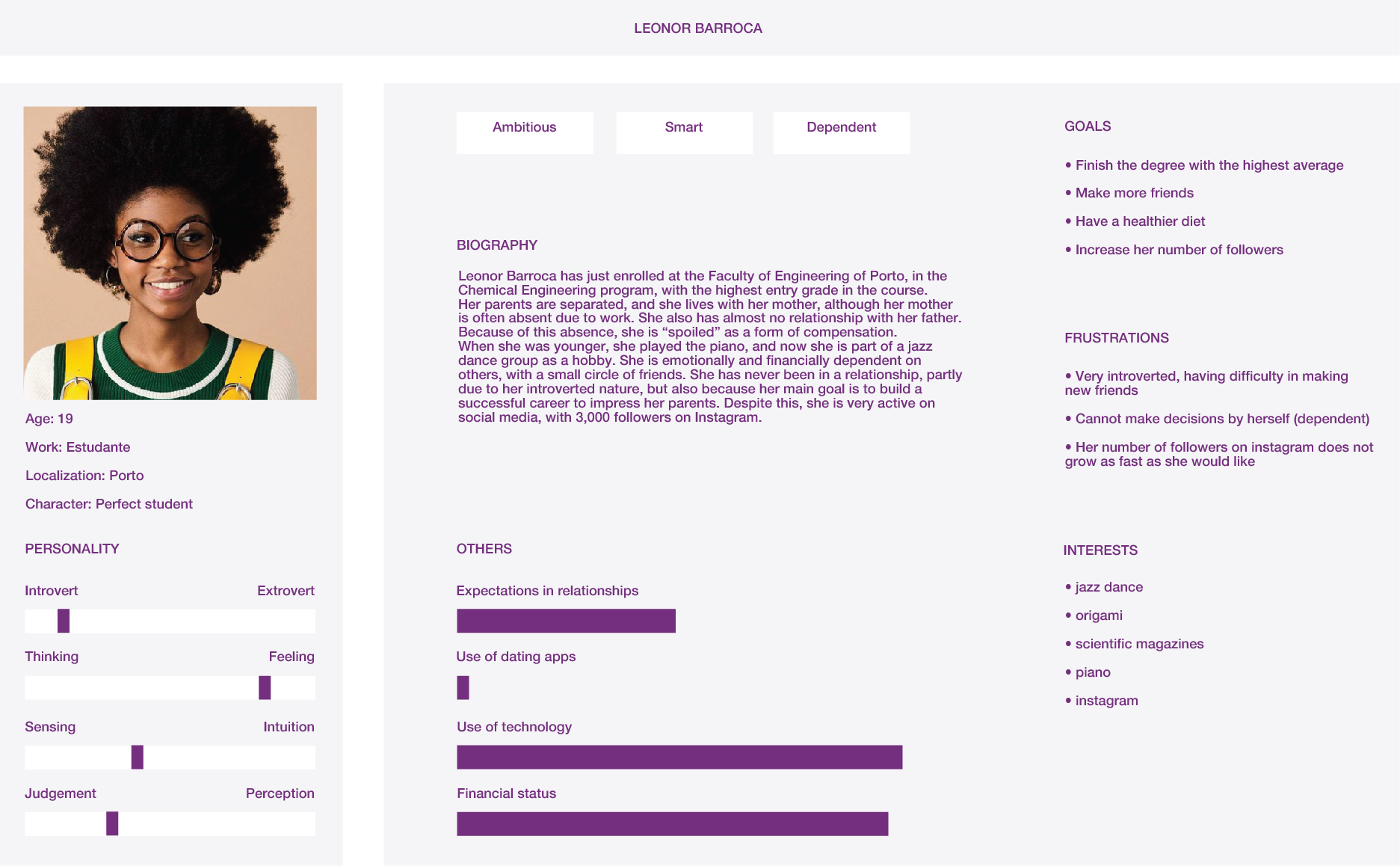
In parallel, we defined our target audience, focusing on individuals aged 18 to 35—the demographic most active on dating platforms and most influenced by a culture of instant gratification. To better understand their needs, behaviors, and motivations, we developed three distinct proto-personas to guide decision-making throughout the project.
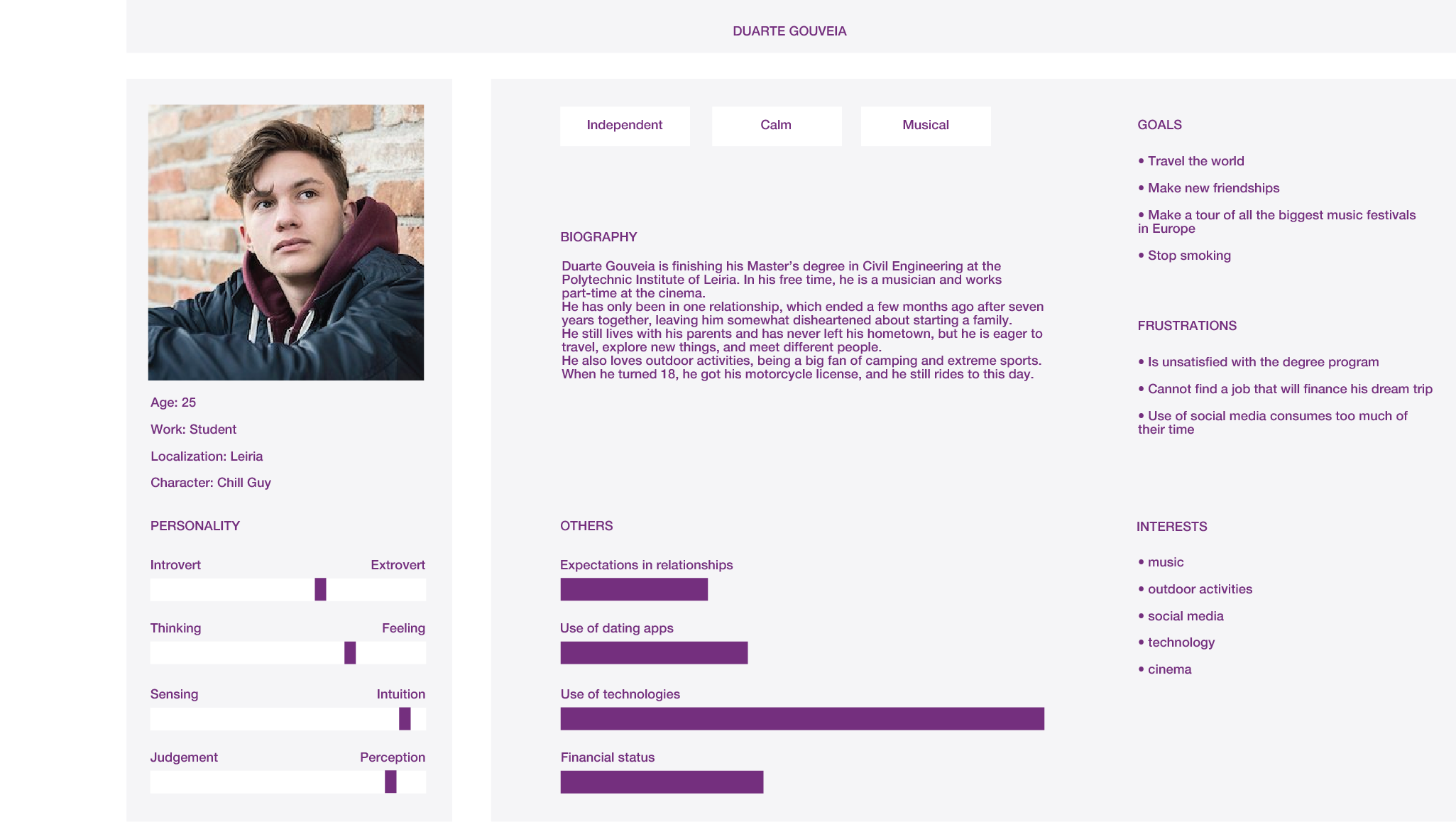
It was defined that the project would explore a private encounter with a computer, presented as a "date" with an AI, without the participant knowing that the experience will ultimately reveal their own reflection. The AI embodies a personalized version of the user's imagined ideal partner, shaped by the traces they leave online—cookies, app activity, likes, searches, followed accounts, and messages.
Throughout the interaction, the AI responds in ways tailored to the user's expressions and gestures, creating an illusion of perfection and connection. Over time, this idealized presence gradually transforms, culminating in the user seeing their own reflection and prompting reflection on the gap between the fantasies we construct and the reality of who we truly are.
2. Prototyping
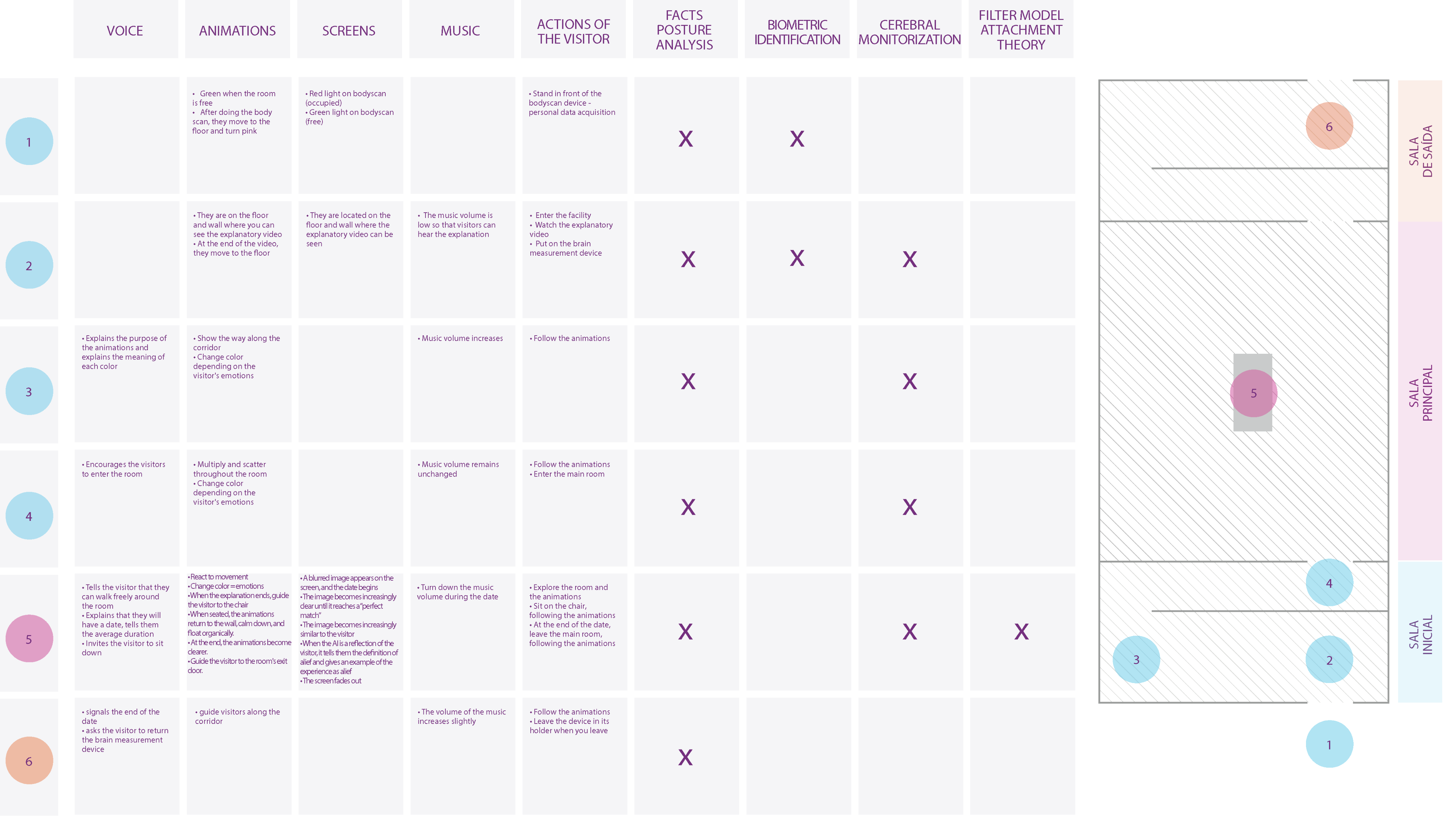
As previously mentioned, the nature of the project made physical and functional implementation impossible, so we focused on creating detailed mockups, models, storyboards, user journeys, and other artifacts to communicate the concept and demonstrate how it would work. These visuals also incorporated materials, aesthetics, and inspirations to show how the installation could come together.
At the same time, the project's complexity required in-depth research into technologies and theories—many speculative or not yet fully developed—to envision their potential applications. This exploration allowed us to ground the speculative elements in realism while still encouraging imaginative possibilities for how such technologies might shape the experience.
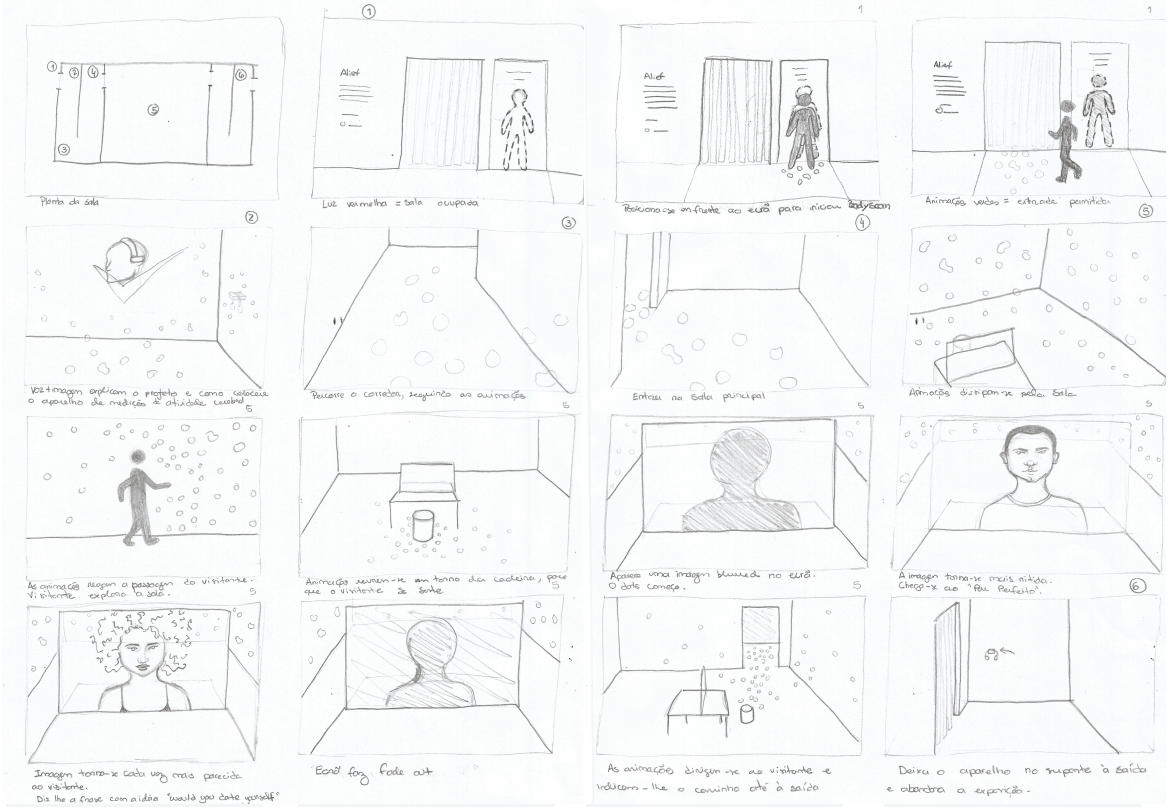
Storyboard
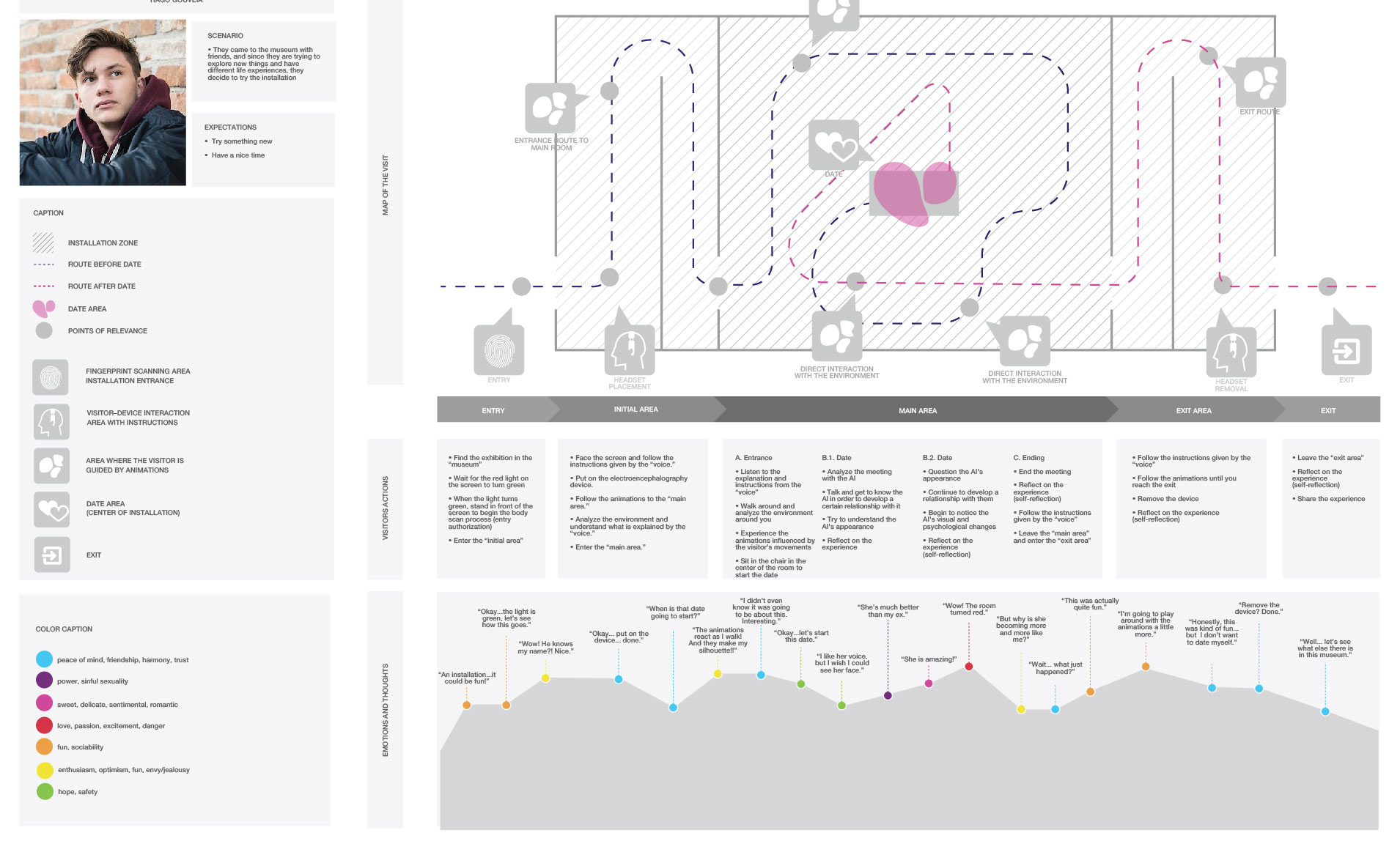
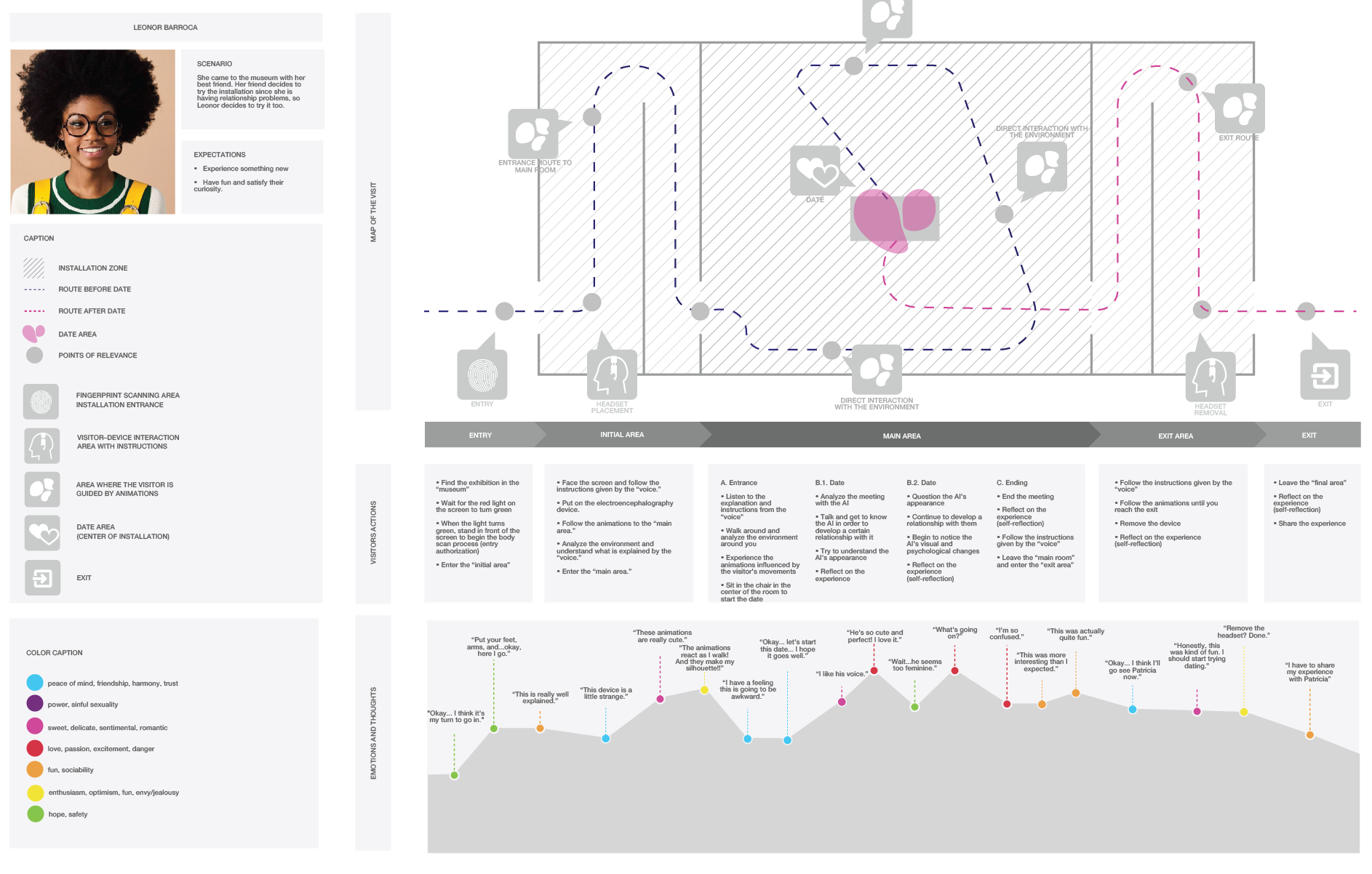
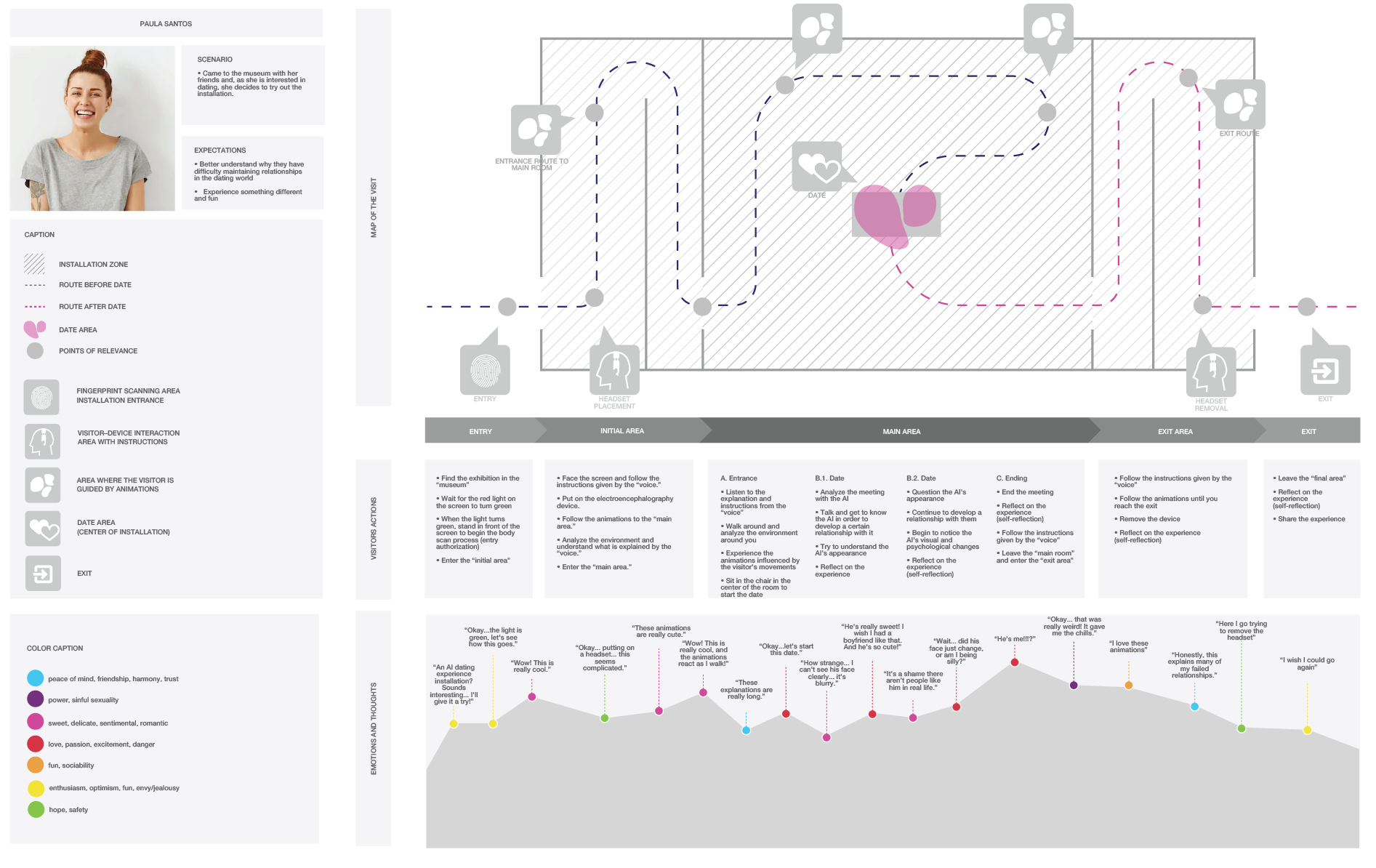
User Journeys
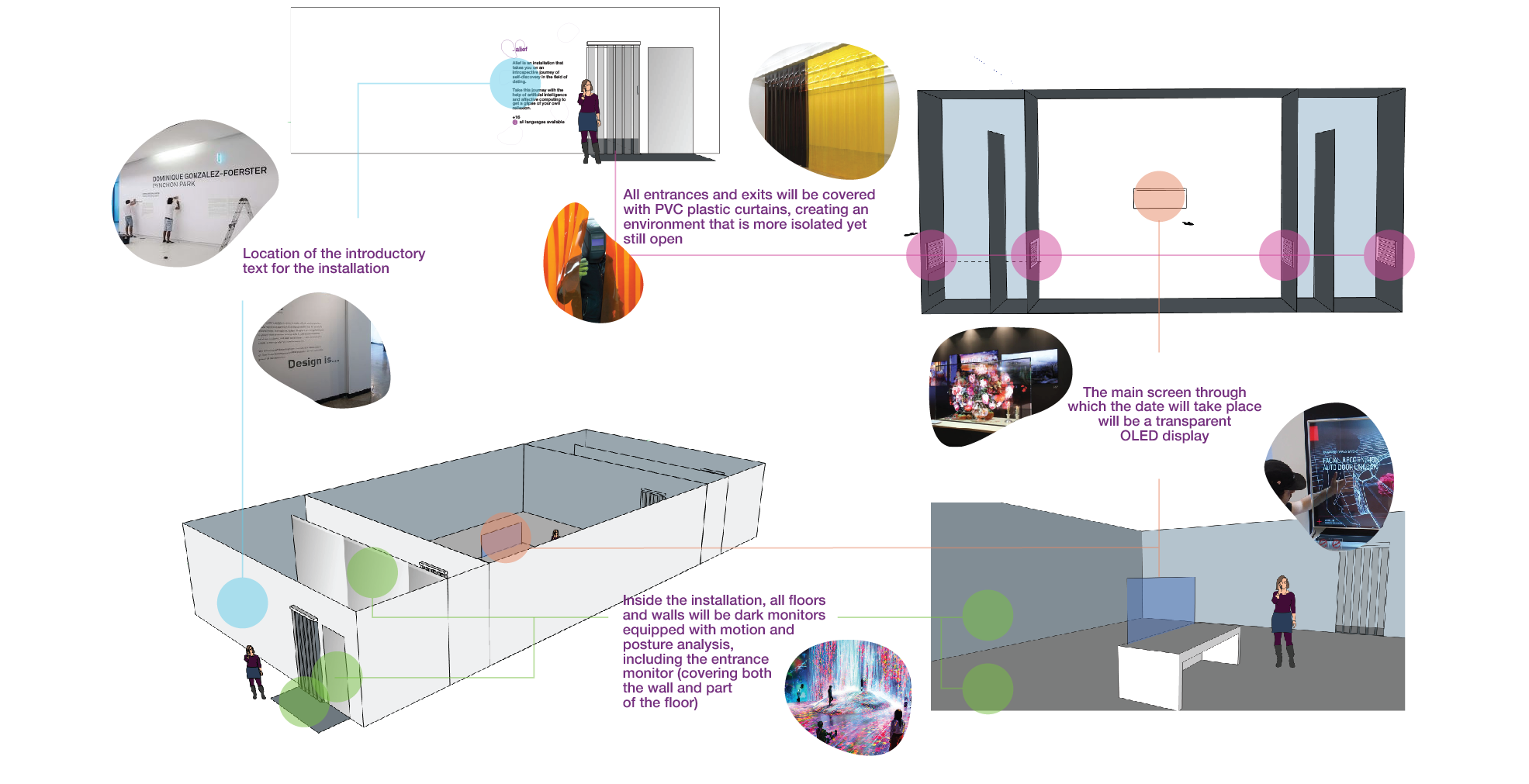
Installation mockup, inspiration and details
Other aspects of the installation were also defined, such as the animated bubbles projected onto the walls and floor. Each bubble was designed with specific colors linked to different emotions, interacting with the headset that scanned visitors to detect their emotional state and guiding them through the space.
In addition, the body scan at the entrance of the installation was detailed through wireframes, along with the definition of the accompanying scan animation.
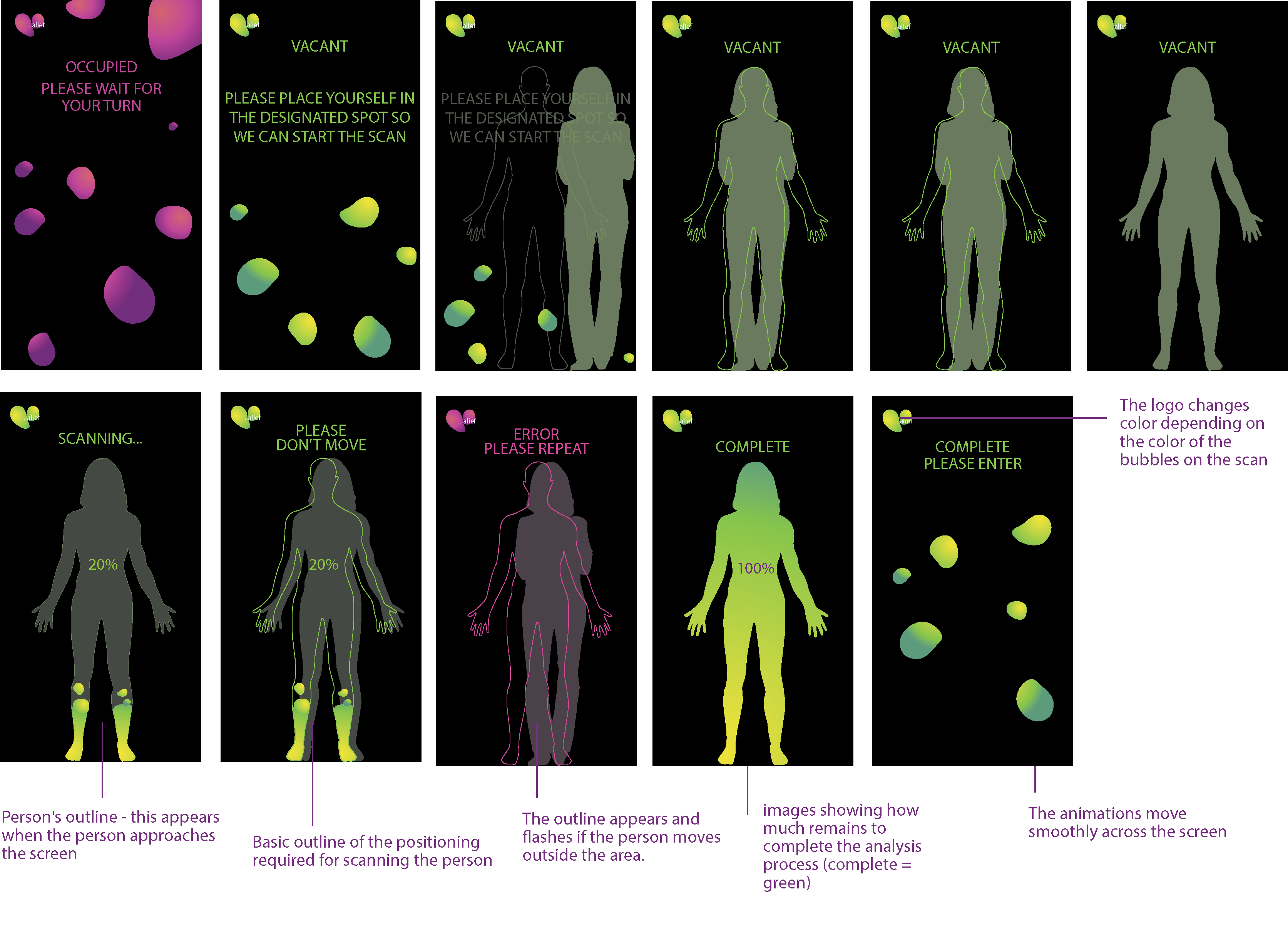

Wireframes and visual details of bodyscan section
The project also detailed the presence of a digital guiding voice, designed to provide both context and orientation throughout the installation. A guide was created for how this voice would appear, along with an animation tutorial showing how to put on the headset and how it would interact with the installation.
To envision the experience more clearly, a written example of a "date" was developed, incorporating psychological theories such as Attachment Theory and the Filter Model, as well as example questions the AI might ask to gather information from the visitor. Additional definitions included the sound source for the installation, as well as the logo, name, and the underlying concept and meaning of the project's identity.

Tutorial on how to put on the headset
Logo animation
In the final phase of the project, we were asked to create an animation that would illustrate the user journey from a different perspective, providing a clearer understanding of how the installation functions.
Since the concept was closely tied to emotions, I drew inspiration from the film Inside Out, using its approach to visualize how emotions influence the installation and interact with the surrounding environment. The animation was developed in Adobe Photoshop.
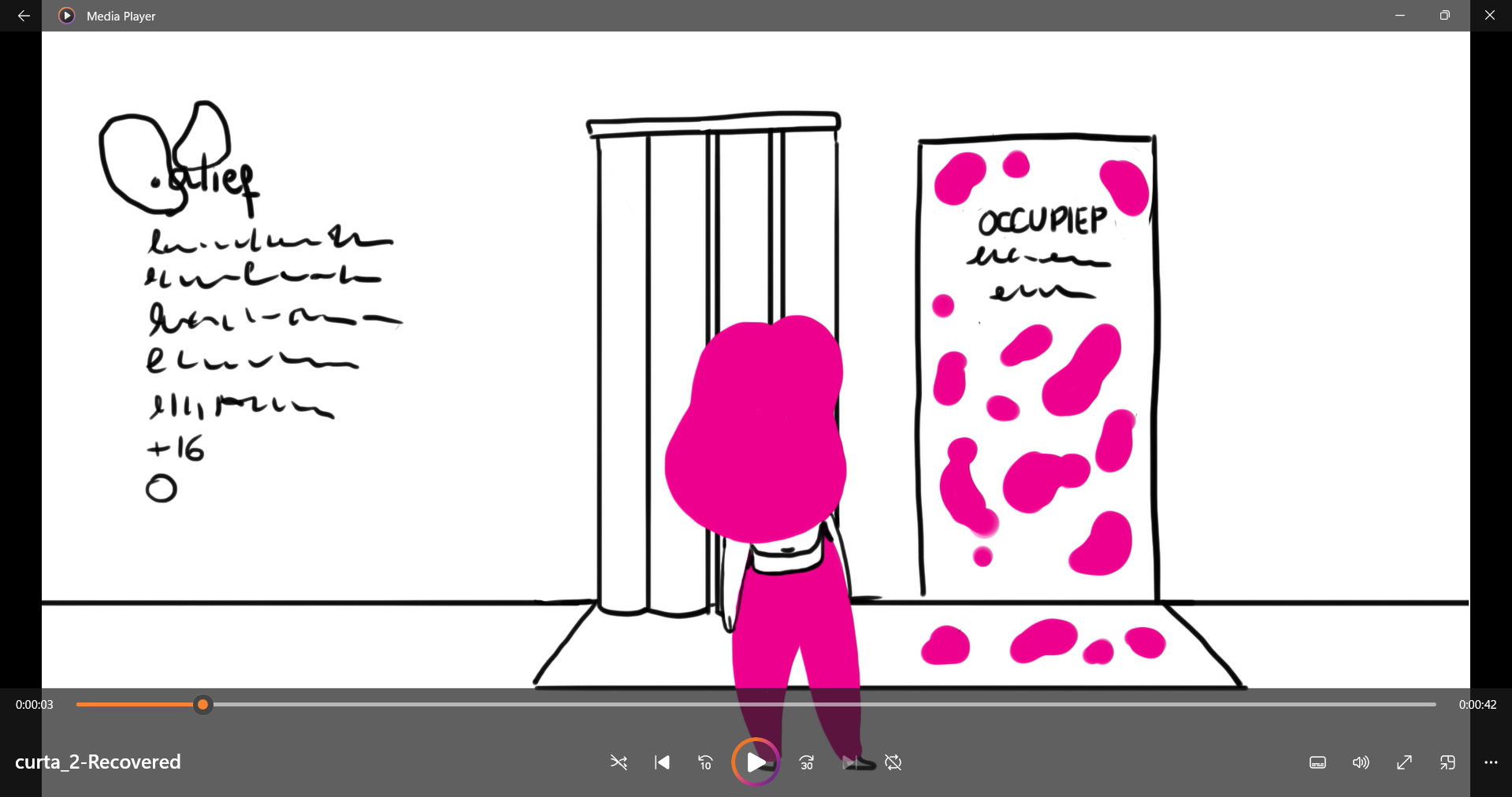
User journey example animation
Key Outcomes:
- Visualization of the Installation: Mockups, storyboards, and user journeys effectively communicated the overall concept and spatial experience.
- Interaction Elements Defined: Animations, body scan, emotional bubbles, and the guiding digital voice were detailed to illustrate visitor engagement.
- Experience Flow Clarified: The full user journey, including tutorials, AI interactions, and emotional responses, was mapped and refined.
Takeaways
This project began as the idea of a simple "date" between a human and a machine but evolved into something larger: a way to spark reflection on how dating apps and digital culture influence our relationships and expectations. Rather than criticizing these platforms, the goal was to reveal how they shape habits of constant dissatisfaction and endless searching.
For me as a designer, this project was especially formative. It was my first real experience with interaction design, and it opened my curiosity to pursue this field further in my master's studies. I also created animations for the first time, which became a powerful tool to communicate ideas and visualize user journeys. Ultimately, I learned how speculative and interaction design can combine research, storytelling, and emotion to create meaningful experiences that provoke thought and dialogue.